
YogaQi™ by Trisoma®
YogaQi is similar to "power yoga", which combines fitness moves and stretches with traditional asana postures in a vinyasa (flowing series of poses) yoga style, with beginner-friendly formats which can also challenge more experienced yogis. Using English names for poses, with no "oming" nor chanting as included in some traditional yoga practices (such as Kundalini yoga). Mat is required and tools are optional, but Trisoma prefers simplicity, to keep concentration on body. The student should not be uncomfortable in any poses, but should expect deep stretching and a revitalizing workout.
YogaFit® Certified Yoga Instructor
After taking classes since the 1970s from hundreds of instructors in USA, Europe and Asia, in many styles of yoga including the Bikram School in Santa Monica. Paul Svacina decided to train with Beth Shaw's YogaFit® Coupled with ACE Fitness Certification, Buteyko Breathing and extensive training in martial arts, physical therapy and bodywork, Paul developed what he termed YogaQi routines which can include aspects of Yoga, Qi Gong, TaiJi melded with modern fitness training and rehabilitation concepts."It's okay to wiggle and sway™"
It is okay to wiggle and sway because the focus is to intently feel the body flowing smoothly with intent while activating the joints and muscles in QiGong style, and then progressing through poses modified to the student's condition and choice at the time, allowing pauses, modified stretches, jiggling and wiggling, shaking out hands, Cobbler Wobbler™[3], etc.; naturally slowing the breath with no chanting. Typically ending with supine lying pose option. Wearing loose clothing, and bringing your mat or large towel, the location may be a room, studio, park or beach. Music is optional.
Benefits
Yoga provides many benefits, including:- Stress management and relaxation. While you shouldn't expect yoga to cure you, it can help some health conditions when combined with treatment recommended by your doctor.
- Increased flexibility. Increased range of motion means you're less likely to injure yourself in other physical endeavors or in your daily activities.
- Management of chronic health conditions. The breathing and relaxation methods used in yoga might help you if you have asthma, carpal tunnel syndrome, depression, low back pain, multiple sclerosis, osteoarthritis of the knees or memory problems. Yoga can also be helpful when combined with other treatments for heart disease and high blood pressure. Yoga has helped reduce cardiovascular disease rates and blood pressure levels.
- Sleep better at night. Increasing circulation, spending energy and relaxation help people sleep.
- Weight loss. Yoga burns calories and can calm your appetite (and sugar cravings).
- Balance. Proprioception and coordination play a bigger role in avoiding falls as we age.
- Improve cancer patient and caregiver quality of life.
- Alzheimer's and other caregiver stress and fatigue, boosting their mood and improving their ability to cope and manage stress.
- as well as risks, such as vertebral compression fractures.

Beginning a session
Beginning a session at any time of day, warming up should include awareness of areas of the body that need extra care, and if there are questions, should inform the instructor so that modification may be suggested. A session typically begins with a Taichicise™ standing warm up, with tai ji and qi gong type movements with slow dynamic stretching within comfortable range of motion to warm up the muscles, soft tissues and joints and to increase circulation, and change student's focus from the external to the internal if indoors; or if outdoors, an emphasis on concordance, omneity and integrity with the natural surroundings.
The main portion
The main portion of the yoga session is "mountains and valleys" (per YogaFit®) progressing into stretching and strength poses of varying difficulty appropriate to the students, where levels of physical and mental exertion increase and work the body and mind. Modifications are encouraged, as well as rolling shoulders, gently flexing necks, flexing wrists, shaking hands, etc.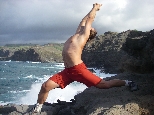
The final phase
The final phase of the session is stretching on the floor, ending in sitting or laying poses, to reach deepening relaxation and parasympathetic dominance. The last pose is typically the corpse pose, for maybe 3-4 minutes, after which students are encouraged to begin moving slowly with fingers and toes, hands and feet, and then further proximally, until slowly rising and later drink water. At the end of a yoga class, you should feel invigorated, yet relaxed and calmed. If this isn't the case, talk to your instructor.Breathing
Breathing should become slow and smooth, not forced, as higher breathing rate and less CO2 in blood actually decreases oxygenation of tissues due to the Bohr effect.[5] Thus beware of some instructors who teach students that Pranayama is to breathe deeply and forcefully, such that their yoga classes sound like an aerospace wind tunnel, with students huffing and puffing as through they were following Lance Armstrong in the Pyrenees. Such exsufflation is a recipe for high blood pressure, cellular malmetabolism and other maladies.
There are many types of "yoga breath", and fallacies abound about their meanings and physiology. True pranayama breathing involves a goal of increasing the duration of the breath retention.[6] Ujjayi breath is also frequently taught as an audible "rushing" of air, however ujjayi breathing by an experienced practitioner is soundless, smooth and slow. Have you ever seen a Buddhist monk panting? Have you noticed that healthy older people do not breathe noticeably, nor with an open mouth? (Click here for more information on breathing, and then ask your doctor.)
Body Awareness
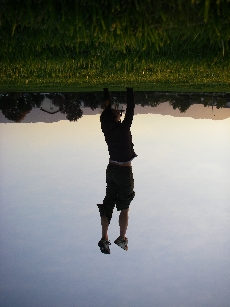
Body Awareness is an essential part of getting more out of yoga. Stop trying and forcing; just relax and feel. Meditation is a great tool, but this modality is about meditation in motion, including Qi Gong elements and fitness moves, with optional unforced pauses, and avoiding ascetic fundamentalism. Instead of jumping and flinging around as in calithenics, or just moving to the next pose, the instructor will help guide transitions between poses. Concentrate with every motion on what each part of your body is doing, and respond with intention. Lengthening the spine, spreading the fingers wide, raising the lower ribs, puling up the crown of the head. Notice where tensions remain, and focus release there. Modifications, substitutions, moving fingers and toes, rotating arm, swinging hips, wiggling and swaying are encouraged at the student's discretion. Ideally, you will forget what happened an hour before your session, and will be entranced into a partially meditative state, allowing your body to concentrate on its condition and reset connections with the nervous system. The converse of this would be, for example, running on a treadmill while reading a magazine, which may degrade your muscle response while associating increased heart rate with reading.
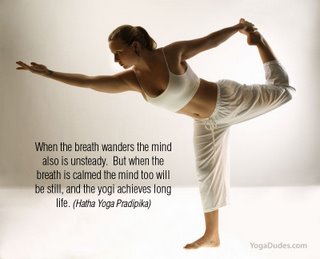
Yoga, derived from the Sanskrit root yuj, "to control", "to yoke", or "to unite", [1] is a group of ancient spiritual practices (tapas, sutras, etc.) originating in India, concentrating on aspects such as meditation, abstinence and poses. Trisoma Yoga is a modern exercise format based on yoga that uses various poses, transitions between poses and awareness of breath and body to build strength, endurance, balance, control, awareness, flexibility and relaxation. There is no competition involved, and it is understood that variance in strength and flexibility is normal and not necessarily associated with health or beneficial results.

Quotes:
An ancient sage said:
When the body is upright
The breath will be smooth
When the breath is smooth
The mind will be still
- from Complete Tai Chi by Alfred Huan
Medical benefits of yoga
...have also become well known by health care professionals. For these reasons it is of no surprise that physical therapists have begun to incorporate the posture techniques of yoga in rehabilitation programs.[7]
(Click for video from Mayo Clinic Minute: Benefits of yoga)
Yoga is now recommended by, and health benefits of yoga are being researched by,
the National Institutes of Health, Department of Health & Human Services, Mayo Clinic Foundation for Medical Education and Research, American Academy of Orthopaedic Surgeons, National Parkinson Foundation, American Academy of Dermatology, International Myeloma Foundation, National Center for Complementary and Alternative Medicine and others:
...
The Mayo Clinic stated-
Yoga offers a good tool for stress management and relaxation.
While you shouldn't expect yoga to cure you, it can help some health conditions when combined with treatment recommended by your doctor.
Yoga is suitable for people of all abilities. Poses range from the easier corpse pose, which involves lying on the floor while completely relaxed, to the most difficult poses that take years of practice to master.
Regardless of which type of yoga you practice, you don't have to do every pose your instructor demonstrates. If a pose is uncomfortable or you can't hold it as long as the instructor requests, don't do it. Good instructors will understand and encourage you not to exceed your personal limits. Spend time sitting quietly or in child's pose,
breathing slowly until your instructor moves the class on to another pose that's more comfortable for you.
Yoga, overall, is generally considered very safe. But there are some situations in which yoga can pose a risk. Check with your doctor or other health care provider before you begin yoga, especially if you have any of the following conditions: High blood pressure, risk of blood clots, eye conditions, osteoporosis, pregnancy, artificial joints.
You may be able to practice yoga in these situations if you take certain precautions.
(Click for video from Mayo Clinic Minute: Benefits of yoga)
Yoga Benefits Survivors' Immune Systems, from Research News by Breastcancer.org.
"Yoga can also be helpful. You don't need to twist your body into a pretzel to practice yoga. Simply sit peacefully, clear your mind, breathe slowly, and follow the simple postures or stretches on your favorite home yoga tape.
Yoga has also been proven to improve the immune system and align the bones in your body. The beauty of yoga is that you go at your own speed. In time, you may notice that postures that once felt difficult and unusual begin to feel natural and energizing." (Mary S. Mittelman, Alzheimer's Healthcare Professional author)
Modest, regular exercise, particularly when combined with stretching and relaxation, or approaches such as yoga and tai chi, provides another essential element for optimum health. (Beth Israel Medical Center Department of Pain Medicine and Palliative Care, New York)
Why Yoga - The Benefits Supported by Science (video by Veterans Health Administration)
Other complementary pain relief techniques include massage, vibration, heat or cold packs or pressure, diet, exercise, relaxation training, yoga, reiki (a natural healing process using the hands to tap a universal life energy) and Jin Shin Jyutsu. The quality of research supporting these approaches varies from therapy to therapy. As with any treatment approach, use of complementary therapies should be discussed with your doctor. (The National Pain Foundation)
Physiological changes promoted in transcendental meditation
[4]
Should people stretch before exercise?
[2]
Breathing is an important part of yoga practice,
but some people, even some Pilates and yoga instructors, think that breathing more will ineluctably increase oxygen levels in the blood. This is not the case, and
breathing too quickly and too deeply may decrease the CO2 levels to unhealthily low levels.
In November 2008, Malaysian Islamic National Fatwa Council banned yoga for Muslims, so if you are muslim, please consult your religious leader before contacting us. For other questions on yoga, visit fora below:
Free Yoga Videos and Pose Photo Guides
References
2. Ian Shrier Should people stretch before exercise? The Western Journal of Medicine. 2001 April; 174(4): 282-283. Copyright ©2001 BMJ Publishing Group. Department of Physiology McGill University Centre for Clinical Epidemiology and Community Studies Lady Davis Institute for Medical Research SMBD-Jewish General Hospital Montreal, Quebec H3T 1E2 Canada (Return to Reference 2 in text)
3. Coined by Rebecca Young (Return to Reference 3 in text)
4. Elias AN, Guich S, Wilson AF. Ketosis with enhanced GABAergic tone promotes physiological changes in transcendental meditation. Med Hypotheses. 2000 Apr;54(4):660-2. Department of Medicine, University of California at Irvine, California 92868, USA. (Return to Reference 4 in text)
5. Buteyko Institute research by Dr. Konstantin Pavlovich Buteyko, et al. (Return to Reference 5 in text)
6. http://www.yogaatwork.co.uk/pranayama.htm (Return to Reference 6 in text)
7. Laura Inverarity, D.O., Yoga Therapy About.com; Patients & Physical Therapy, Updated: January 22, 2008 (Return to Reference 7 in text)
Images
2. 2008 by Paul Svacina.
3. 2008 by Ladislav.
4. 2008 Rebecca by Paul Svacina.
5. courtesy of Yogadudes.com
6. Paul Svacina and Delphine Louie by Rebecca